Blog · Buyer's guide
How to Choose a Fence Material for Reno's Climate
Every generic buyer's guide ranks fence materials on looks and price. This one starts from Reno's actual wind, sun, frost, and soil — the four things that determine which material still looks good in ten years.
Last reviewed September 9, 2026. Prices and rules are rechecked before each republish.
Quick answer
As of September 2026, the right fence material for a Reno property depends on which of four local conditions — the Washoe Zephyr's afternoon wind, high-desert UV exposure, a 24-inch frost line, and rocky decomposed-granite soil — matters most for your specific yard and goals, not on a generic national ranking of materials.
Source notes and the full breakdown follow below. — Reno Apex Fence
The four conditions that actually decide this for you
Before comparing materials, it helps to name what you're actually choosing against. Four conditions specific to Reno and Washoe County drive almost every material recommendation on this site:
Wind. The afternoon westerly locals call the Washoe Zephyr loads a solid fence panel like a sail. Washoe County's adopted design wind speed for residential structures is 120 mph — a serious number that tells you how much this is taken into account in local construction standards.
UV. At roughly 4,500 feet, Reno's sun is more intense than at sea level, and it's the primary reason unstained wood dries, checks, and sheds fasteners faster here than in a milder or more humid climate.
Frost. Washoe County's listed frost line is 24 inches. Post depth below that line — not the fence material itself — is usually what actually determines whether a fence survives its first serious winter freeze-thaw cycle.
Soil. Much of the valley floor and every foothill neighborhood sits on decomposed granite and rock, which affects installation difficulty and cost more than it affects any specific material's long-term performance.
With those four in mind, here's how each common material actually performs.
Wood: cedar and redwood
Cedar and redwood are the two species Reno installers most often quote, at $20–$50/ft installed. Both resist rot and insects naturally better than most other softwoods, which is their real advantage — but neither is immune to Reno's UV. Unstained or unsealed wood grays, checks, and loosens fasteners within a few years regardless of species; a stain or sealer applied within the first season and reapplied every two to three years is what actually determines whether a wood fence looks good at year ten or needs board replacement by year six. For wind performance, ask specifically for board-on-board or shadowbox construction rather than a solid single layer of boards — the overlap lets gusts bleed through the panel instead of loading it edge to edge like a sail, which is the single biggest wind-related failure mode covered on the repair page.
Choose wood if: you want the most traditional residential look, you're comfortable with a recurring maintenance schedule, and your HOA (if any) allows it — check HOA fence rules in Nevada before you commit, since several Reno-area communities specify an approved stain color.
Vinyl
Vinyl privacy fencing runs $30–$60/ft installed and is the lowest-maintenance solid-privacy option available — no staining, no rot, no insect damage. Modern UV-stabilized vinyl holds its color in Reno's sun far better than the vinyl of fifteen years ago, which softened this material's biggest historical weakness. The real quality variable today is wall thickness and rail reinforcement: cheap, thin-walled panel stock can get brittle in a hard winter cold snap and crack under wind load, while a thicker wall with an aluminum-reinforced bottom rail holds up to the same Washoe Zephyr gusts that damage a poorly-built wood fence. Ask specifically about wall thickness and rail reinforcement when comparing vinyl quotes — the vinyl installation page goes deeper on grade specifications.
Choose vinyl if: low long-term maintenance matters more to you than the lowest possible install cost, and you want a clean, uniform look that won't need refinishing.
Chain link
At $9–$30/ft installed, chain link is both the cheapest option and the best wind performer of the group, for a simple reason: there's nothing solid for the wind to push against. It's also essentially maintenance-free — galvanized or black vinyl-coated mesh shrugs off UV and freeze-thaw cycling in a way wood never will. The tradeoffs are aesthetic and functional rather than structural: no privacy, and a look that reads as utilitarian rather than residential for a lot of buyers, which is why it's most often chosen for side yards, dog runs, rural and agricultural fencing (relevant for larger Washoe Valley and Palomino Valley parcels), or as a budget-driven choice where an HOA doesn't restrict it. Black vinyl-coated fabric softens the look for a modest per-foot premium if it's going anywhere visible from the street.
Choose chain link if: budget or wind performance matters more than privacy or curb appeal, or the fence is for containment (pets, livestock, a construction perimeter) rather than a privacy statement — and confirm your HOA allows it first, since many restrict or ban it for street-facing fences.
Ornamental aluminum and wrought iron
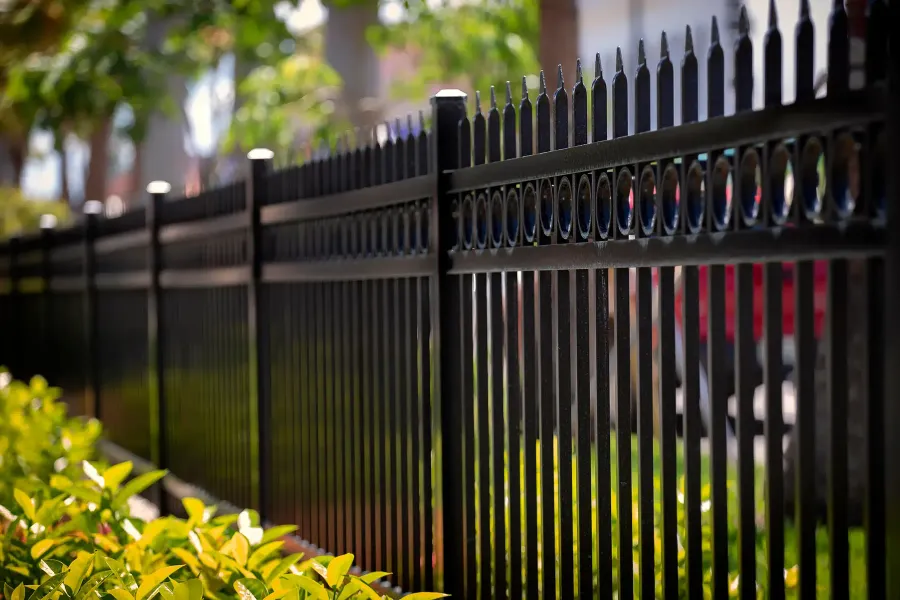
Open-picket ornamental metal handles wind the way chain link does — nothing for gusts to load against — while looking considerably more residential, which is why it's a common choice for front yards where Washoe County's 4½-foot setback height limit already rules out a tall privacy fence anyway. Aluminum won't rust and needs essentially no upkeep; true wrought iron is heavier, custom-fabricated, and priced accordingly at $50–$85 per linear foot — a meaningful step up from aluminum, but the choice for a buyer who wants a genuinely custom, architectural look rather than a manufactured aluminum profile.
Composite fencing: the newer option
Composite fencing — a blend of wood fiber and recycled plastic — has a wide national price range of $20–$85/ft installed, reflecting how much quality and brand vary in this category more than in the more established materials above. Composite is engineered specifically to resist the two things that wear out real wood in Reno: it doesn't rot, and better-made composite boards resist UV fading and checking far longer than an unstained cedar board. It's a reasonable middle option between wood's look and vinyl's low maintenance, at a cost that can land anywhere from competitive with wood to well above vinyl depending on the specific product — get a named product and manufacturer warranty in any composite quote, since "composite" alone describes a wide quality range, not a single spec.
Choose composite if: you want wood's aesthetic with less maintenance and are willing to research a specific product line rather than treat "composite" as a single, interchangeable choice.
Resale value and a note on sustainability
For a fence a buyer might see as an asset rather than a maintenance obligation, vinyl and well-maintained wood generally photograph and show best for resale in a typical Reno subdivision, since both read as a finished, intentional privacy solution. Chain link, while functionally sound, is more often perceived as utilitarian and can occasionally read as a minor drawback in a listing unless it's clearly serving a specific purpose (a dog run, a side-yard utility area) rather than the primary sight line from the street or a main living area. None of this is a reason to avoid chain link where it's the right functional choice — it's a reason to think about where on the property each material goes, not just which one to use everywhere.
On sustainability, cedar and redwood are renewable but require replacement and periodic chemical treatment over their lifespan; vinyl is a long-lived plastic product that doesn't biodegrade but also doesn't need replacing as often; composite specifically markets recycled content as a selling point, for buyers for whom that matters. None of these materials has a clearly superior environmental profile once full lifecycle (manufacturing, maintenance chemicals, replacement frequency) is considered — treat any strong claim to the contrary from a single manufacturer with some skepticism.
You don't have to pick just one
Every section above compares materials as if a property needs a single, uniform answer, but plenty of well-planned Reno properties mix materials by zone rather than fencing the whole lot in one product. A common pattern: vinyl privacy panels along the rear and side yards facing neighbors or a patio, paired with an open ornamental metal or shorter picket section across the front yard where the county's 4½-foot setback limit already favors an open look over a solid panel anyway. A rural or larger parcel might combine chain link or range fencing around a pasture or side acreage with a nicer material closer to the house. Mixing materials by zone can also help a mixed budget stretch further — spending more per foot where privacy and curb appeal matter most (the back yard, the street-facing front) and less where the fence is purely functional (a side yard, a dog run, a rear property line backing to open desert). The main thing to watch when mixing materials is a consistent post and cap style at the transition points, so the change reads as an intentional design choice rather than two unrelated fences bolted together.
Side-by-side snapshot
| Material | Installed cost | Best for |
|---|---|---|
| Chain link | $9–$30/ft | Budget, wind performance, containment |
| Wood (cedar/redwood) | $20–$50/ft | Traditional look, willing to maintain it |
| Vinyl | $30–$60/ft | Low maintenance, uniform privacy |
| Ornamental aluminum | $25–$75/ft | Front yards, open decorative look |
| Wrought iron | $50–$85/ft | Custom, architectural front yards |
For the full cost-versus-durability math over a 20-year horizon, see wood vs. vinyl vs. chain link fence cost, and for whole-project pricing by fence length, the complete cost guide.
A quick decision shortcut
Need privacy and want the lowest long-term maintenance? Vinyl.
Need privacy, love the traditional look, and don't mind resealing every few years? Wood.
Don't need privacy, want the lowest cost and best wind performance? Chain link.
Front yard under the 4½-foot limit, want an open decorative look? Ornamental aluminum or wrought iron.
Sources. Cost figures: HomeGuide, Fence Installation Cost (Feb 2026), national contractor estimates — see the cost guide for Reno-specific installer rates. Design wind speed and frost line: Washoe County Construction Design Requirements, read September 9, 2026.
Frequently asked questions
What's the best all-around fence material for Reno? +
There isn't a single best material — it depends on what you're optimizing for. Vinyl privacy panels are the best low-maintenance choice for most subdivision back yards; chain link is the best value and wind performer for side yards, rural fencing, and dog runs; wood offers the most traditional look for buyers willing to reseal it periodically; ornamental metal is the best choice for a front yard under the 4½-foot setback limit where an open, decorative look is the goal.
Does Reno's dry climate mean wood fencing lasts longer here than elsewhere? +
Not necessarily — dry climates reduce rot risk but increase UV-driven drying, checking, and fastener failure, so wood in Reno needs the same or more frequent staining and sealing as in a wetter climate, just for a different reason.
How does Reno's wind affect material choice specifically? +
Solid privacy materials (wood, vinyl) act like sails and depend heavily on posts set below the county's 24-inch frost line to survive gusts under Washoe County's 120 mph design wind speed; open materials (chain link, ornamental metal) let wind pass through and rarely fail structurally from wind alone.
What fence material needs the least maintenance in Reno? +
Vinyl and chain link both need essentially no scheduled maintenance beyond occasional cleaning, compared to wood's recommended stain-and-seal cycle every two to three years.
Should I choose my fence material before or after getting quotes? +
Before, if possible — deciding on a material first lets you compare true apples-to-apples quotes and avoids the common timeline problem of switching materials mid-quote-shopping, which the installation timeline guide covers in more detail.
Get matched with a local fence pro
No obligation. We'll connect you with an independent local contractor.